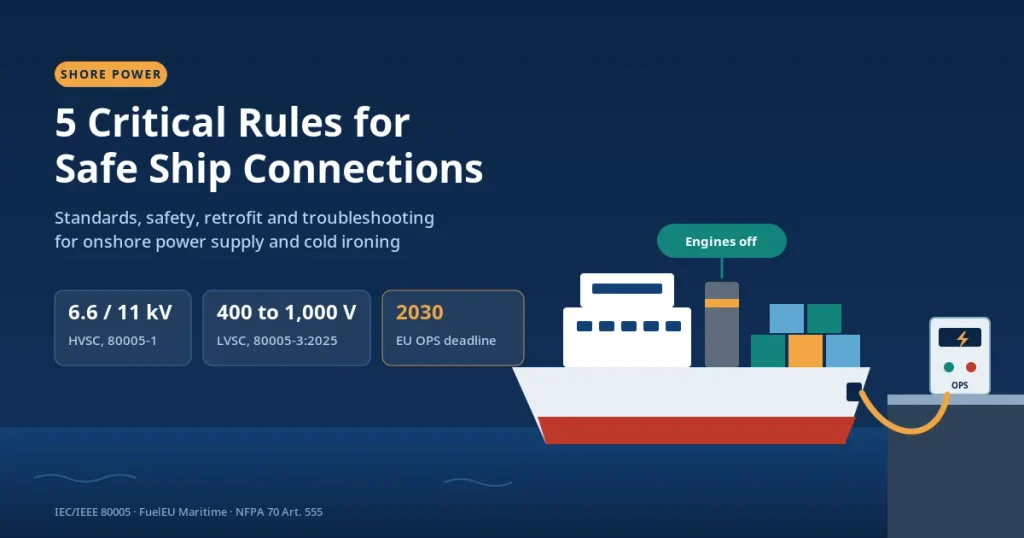
Shore power, also known as onshore power supply (OPS), cold ironing or alternative maritime power (AMP), transfers power from the grid electricity to the ship during the berthing of the ship, so that the auxiliary engines of the ship are shut down. Large ships are connected to 6.6 kV or 11 kV according to IEC/IEEE 80005-1, and smaller ships use 400 V to 1,000 V low-voltage systems.
Is your vessel ready for a berth that now accepts it to plug in? Does your crew still regard shore cable as a secondary matter in dock operations? Shore power connection seems to be very simple from the wharf operation site. In fact, any mismatch in voltage, frequency, grounding or interlocks may lead to switchboard tripping, equipment damage, and even injury to the mooring personnel. This guide covers the standards, safety rules, retrofit choices, and troubleshooting steps that determine whether the connection can be successfully completed.
What Shore Power Is and Why Ports Now Demand It
Shore power uses grid electricity instead of marine diesel auxiliary power generation during ship mooring. In 2025, Transport & Environment reported that in 2023, 8.3 million tonnes of CO2 will be emitted by ships berthing in European ports, accounting for 6.4% of shipping emissions in the region. This part of the combustion emissions on the wharf can be eliminated after access to shore power.
Onshore power supply is the term of EU regulation, cold ironing is the old term used by seafarers, and alternative maritime power is more common in North American and Chinese ports. All describe the same transfer of hotel load: lighting, HVAC, pumps and reefers.
Because the cold ironing name dates from coal-fired iron engines that cooled once the ship tied up, it hides a modern detail. The switchover is not a simple plug-in. The ship synchronises its generators with the incoming supply, transfers load in steps, and only then stops the engines, so passengers and equipment never see a blackout.
After the shore power is connected to the receiving switchboard, the ship is powered by the same in-ship power distribution system as the generator power supply. Therefore, the aging of sockets and seals also needs attention when berthing and sailing. When many maintenance supervisors carry out shore power, they will also simultaneously check the IP56 watertight plugs and sockets used in ship power distribution.
Shore Power Connection Standards: HVSC, LVSC and Small Craft
Three rulebooks basically cover all shore power connections. In December 2025, ISO and IEC issued IEC/IEEE 80005-3:2025, the first formal international standard for low-voltage shore connection (LVSC), which is suitable for systems with berthing power requirements of not more than 1 MVA, rated 400 V to 1,000 V, and current of 250 A and above. High-voltage ships follow IEC/IEEE 80005-1.
IEC/IEEE 80005-1 is for ships with electricity demand of 1 MVA and above, or the main power supply itself is high voltage. Its plugs and sockets are based on IEC 62613, which stipulates that the maximum rated value of the accessories is 12 kV and 500 A. The 2019 edition has been revised twice in 2022 and 2023, so the revised edition should be indicated in the procurement technical specification.
The new 80005-3 fills a long gap. Before December 2025, the low-voltage shore power connection relies on earlier technical documents, which are interpreted by shipyards themselves. This standard does not apply to inland ships, power supply during dock repair, and systems operated by ordinary persons (i.e.non-trained professionals). Therefore, leisure ships such as yachts are still managed by small ships and wharf-related specifications.
| Tier | Governing standard | Nominal voltage | Typical demand | Who connects |
|---|---|---|---|---|
| High-voltage shore connection (HVSC) | IEC/IEEE 80005-1:2019 + AMD1:2022 + AMD2:2023 | 6.6 kV or 11 kV AC | 1 MVA and above (cruise, large container ships) | Trained ship and shore personnel |
| Low-voltage shore connection (LVSC) | IEC/IEEE 80005-3:2025 | 400 V to 1,000 V AC, 250 A and above | Up to 1 MVA (ferries, supply vessels, feeders) | Trained ship and shore personnel |
| Small vessel and marina | IEC 60092-507, ISO 13297, NFPA 70 Article 555 (US) | 120 V to 400 V AC | Single-cord pedestal supply | Owners and crew |
Frequency is a trap that most guides ignore. Frequency converters are required when a 60 Hz ship is docked to a 50 Hz power grid and now the 80005-3 already clarifies it clearly. There are additional requirements for the tanker: the connection point may be located near the gas-dangerous zones, and the surrounding equipment must meet the hazardous-area certification of the tanker deck equipment.
Shore Power Safety Rules Every Crews Should Apply
Most shore power accidents are caused by earth fault, live plug-in or poor communication between ship and shore. In 2025, the International Association of Classification Societies (IACS) issued Recommendation 182: Shipowners are required to have a pre-connection checklist, perform a lockout/tagout, and conduct a complete retest when two berths at the same power supply point are separated by more than 12 months.
For high-voltage systems, IEC/IEEE 80005-1 mandates the setting of a safety circuit. The loop current shall not be less than 50 mA; when the circuit is disconnected, the circuit breakers on both sides of the ship must be tripped simultaneously within 200 ms. The earthing switches must be interlocked, and the neutral earthing resistor must be able to withstand at least 25 A current for 5 seconds.
IMO has established the operational baseline in MSC.1/Circ.1675,its interim guidelines on safe OPS operation for ships on international voyages. Those guidelines call for designated persons in charge on both sides and working voice communication before any switching. For tankers, they allow special consideration.
There is another danger at the marina: electric shock drowning (ESD, not “electrostatic discharge” here). Leakage from a faulty ship can energize the fresh water around the wharf, and its current is much lower than the action value of the circuit breaker. Do not plug with load, do not swim near the ship connected to shore power, and regularly test the leakage protection device on the ship.
Watertight integrity is part of electrical safety. After water enters the input socket box or cable gland on the open deck, it may create a conductive path between the live and earth conductors before the person finds the damage. The same watertight junction box rules under 46 CFR should be followed for each housing between the shore power input socket and the switchboard.
Planning a Shore Power Retrofit: Rules, Readiness and Compatibility
At present, the main factor driving most shore power conversions is regulations, not fuel savings. Since January 1, 2030, the FuelEU Maritime requires container ships and passenger ships above 5,000 GT to use shore power or zero-emission technology when berthing at ports covered by AFIR. According to the European Commission’s announcement in January 2025, the obligation will be extended to all EU ports providing shore power from 2035.
California implemented it first. CARB’s 2020 At Berth Regulation already covers container, reefer and cruise calls, and in 2025 it phased in tankers at Los Angeles and Long Beach plus ro-ro vessels statewide. CARB audit data showed compliance above 95% in 2024. Remaining tanker terminals follow from 1 January 2027, according to DNV.
The port is the main limiting factor. In 2025, a DNV study for Transport & Environment found only 21% of the OPS connections required by 2030 (93 of 448) installed or contracted across 31 European ports. Container berths lagged at 11%, against 41% for passenger ferries and 35% for cruise ships.
Retrofit reality check: Fitting the ship only solves part of problems. If the berth is not ready by 2030, the ship will need to retain written proof that the connection is not available or compatible, as FuelEU’s exemption depends on this record.
Practical modification scope includes five decisions:
- Choose the connection side and height according to the frequent dock;
- Determine the capacity of the shore power receiving distribution board and its protection device;
- Then determine the installation position of the frequency conversion device;
- If it is necessary to supply power to low-voltage ships with high-voltage power supply, an additional transformer is added;
- Finally, obtain the class approval and prepare the operation file required by IACS Rec.182.
Component paperwork and design also need to be strictly reviewed. When the cable reels, plugs and switchgear are delivered, it shall be accompanied by a type-approval certificate approved by the classification society. Buyers who have mastered how to check the wheelmark and type-approval markings can reduce the most costly delivery accidents.
Shore Power Troubleshooting and Maintenance
Nuisance trips after the upgrading yacht terminal usually indicate that there is leakage on the ship, rather than shore power pile failure. In November 2025, the Washington Public Ports Association reminded operators in a briefing that NFPA 70 Article 555 limits the grounding fault action value of shore power outlets to 30 mA, effective as of January 1, 2026, and that existing facilities do not benefit from grandfathering.
It’s rare to detect small current imbalances in old shore power piles, so many ships continue to operate for many years in the presence of faults. Most commonly, the neutral-to-earth bond remains in place when the ship is connected to shore power; this bond should exist only when the generator is running. Boats with two inlets that share a neutral bus trip for the same reason.
| Symptom | Likely cause | First check |
|---|---|---|
| Pedestal trips the moment the main breaker closes | Neutral-to-earth bond left closed on shore supply | Transfer switch, inverter and generator bonding |
| Trips only when two cords are connected | Two inlets sharing one neutral bus | Separate neutral bars per inlet |
| Plug or inlet warm, discoloured or melted | Corroded or loose contacts raising resistance | Replace both mating halves, then torque terminals |
| Ship cannot synchronise or rejects the supply | Frequency, phase rotation or harmonic mismatch | Compatibility assessment and THD check |
| HVSC safety loop opens repeatedly | Damaged pilot contacts, cable strain or E-stop | Plug pilots and cable management system |
The fault should be isolated step by step. First disconnect all the circuit breakers on the ship, access to shore power, and then close each loop one by one until the trip again. If the trip is still tripped when all disconnected, the cable, inlet and galvanic isolator should be checked before judging whether it is a terminal fault.
Maintenance can avoid faults before they occur. Check the plug and shore power inlet for pitting corrosion every month, check the connection temperature with infrared temperature measurement when loaded, and replace the aging seals. IACS Rec.182 requires that shore-based power supply components be included in the planned maintenance system and the insulation resistance test records be saved. Corroded sockets on the deck can be replaced with IMPA-coded brass and nylon sockets.
Conclusion
Shore power is now a compliance requirement, not an optional environmental bonus. First, match the applicable standard: IEC/IEEE 80005-1 applies to high-voltage ships, the new 80005-3:2025 applies to low-voltage connections within 1 MVA, and marina and small-craft standards apply to small ships. Safety circuit, grounding and operation procedures should be built in from the design stage. Retrofits should be planned around the 2030 deadline and the actual readiness of berths, and every nuisance trip should be treated as a sign of earth leakage.
FAQ
Usually because the ship leaks current to earth. The shore power pile built according to NFPA 70 Article 555 trips at 30 mA or less, so the previously untreated faults of the old wharf will now be cut off. Please check whether the neutral-to-earth bond remains intact when shore power is connected, whether the two input sockets share a common neutral, and whether there is water or moisture in the input sockets.
Yes, for certain vessel types. From 1 January 2030, container ships and passenger ships above 5,000 GT must use shore power (OPS) or an alternative zero-emission technology when at berth in ports covered by Article 9 of the EU’s AFIR regulation. From 1 January 2035, the requirement extends to all EU ports that develop OPS capacity. Key exemptions include port stays of under two hours, unavailable OPS connections, and incompatible equipment.
Increasingly yes, but there are still few tankers equipped with shore power. California’s CARB has incorporated tankers from the Port of Los Angeles and Long Beach into berth regulation in 2025, and the remaining tanker terminals in California will be included on January 1, 2027. IMO interim guidelines allow special consideration for tankers because of hazardous-areas near the cargo manifold.
Test on first connection at each new supply point, then follow the planned maintenance system. IACS Rec.182 accepts limited verification when repeat calls fall within 12 months and nothing has been modified, but full testing returns once that interval is exceeded. Marina users should also test onboard leakage protection regularly.
When choosing a shore power system for a vessel, you need to match the ship’s electrical requirements, the port’s available supply, and the operational environment. A system that is correctly sized can allow the vessel to shut down auxiliary engines while at berth, reducing fuel use and emissions.
As of late 2026, shore power for ships – also called cold ironing or onshore power supply (OPS) – is moving beyond simply “plugging a ship into the grid.” The biggest innovation is the integration of shore power withbatteries, microgrids, automation, digital controls, and bidirectional energy flows.
Yes, shore connection solutions – commonly known as shore power, cold ironing, or alternative maritime power (AMP) – can dramatically reduce port emissions. When docked, ships typically run auxiliary diesel generators to power their onboard systems, lighting, heating, and cooling (known as “hoteling”). By plugging into land-based electrical grids, ships can shut down these auxiliary engines entirely while at berth.