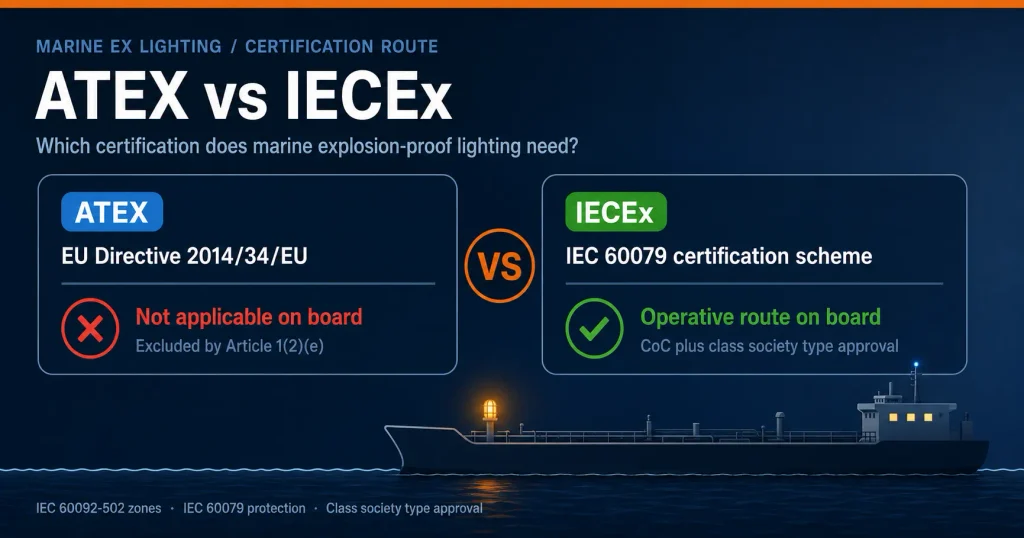
For marine hazardous-area lighting, ATEX and IECEx cannot be treated as interchangeable certifications. The applicable requirements depend on the vessel’s flag state, classification society, hazardous-area classification and project specifications.
Have you ever had a Zone 1 deck lamp rejected during final inspection because of an incorrect combination of certificates? Or have you paid certification fees for the same lamp under both ATEX and IECEx? In onshore applications, the choice between ATEX and IECEx is clear. On the deck of a product tanker, however, this issue involves three levels: flag state law, classification society rules, and IEC 60092 area classification. The wrong assumption often only comes to light at the final inspection stage.
Why the ATEX vs IECEx Choice Changes at the Waterline
ATEX has no legal effect on shipboard equipment. Article 1(2)(e) of Directive 2014/34/EU excludes seagoing vessels, mobile offshore units and their onboard equipment on the grounds that such equipment is regulated by the IMO Convention. DNV also explains the same exclusion to manufacturers in its publicly available ATEX product certification guidelines.
This exclusion appears in the scope provisions, not in the exemption provisions. As a result, there is no CE marking certification path for luminaires specifically sold for use on the cargo decks of oil tankers. Suppliers may still hold valid ATEX certificates – and many do – but the certificate cannot address the questions raised by the classification society surveyor on site.
The surveyor follows a different verification process. The SOLAS Convention, together with the IGF Code or IGC Code, defines the safety objectives; IEC 60092-502 defines the hazardous area boundaries; and the IEC 60079 series defines the explosion protection type of the equipment. A certificate can only prove compliance with the third requirement, which is why the certificate alone usually cannot clear an inspection deficiency.
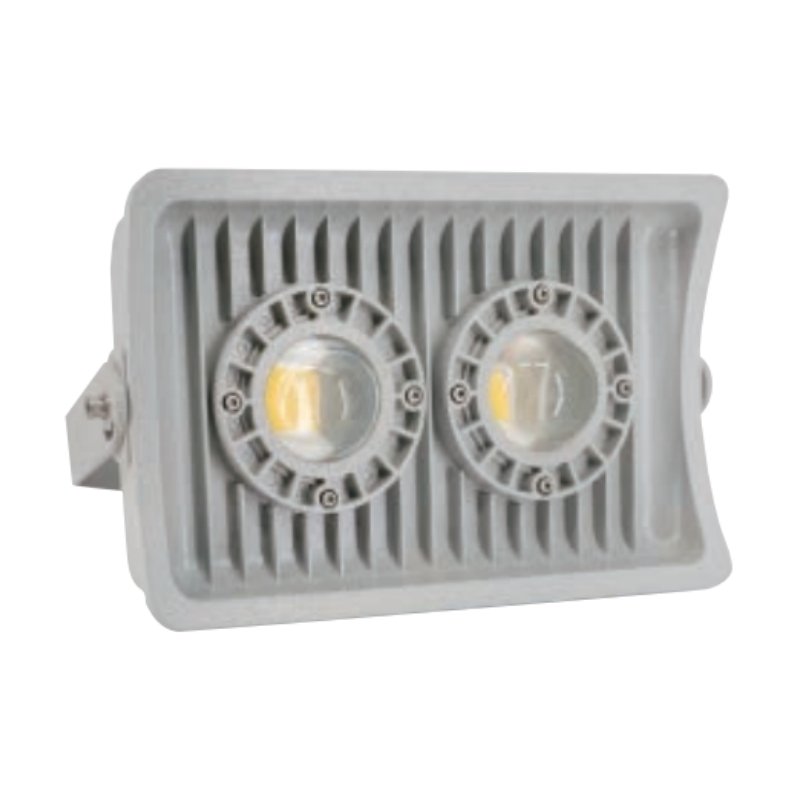
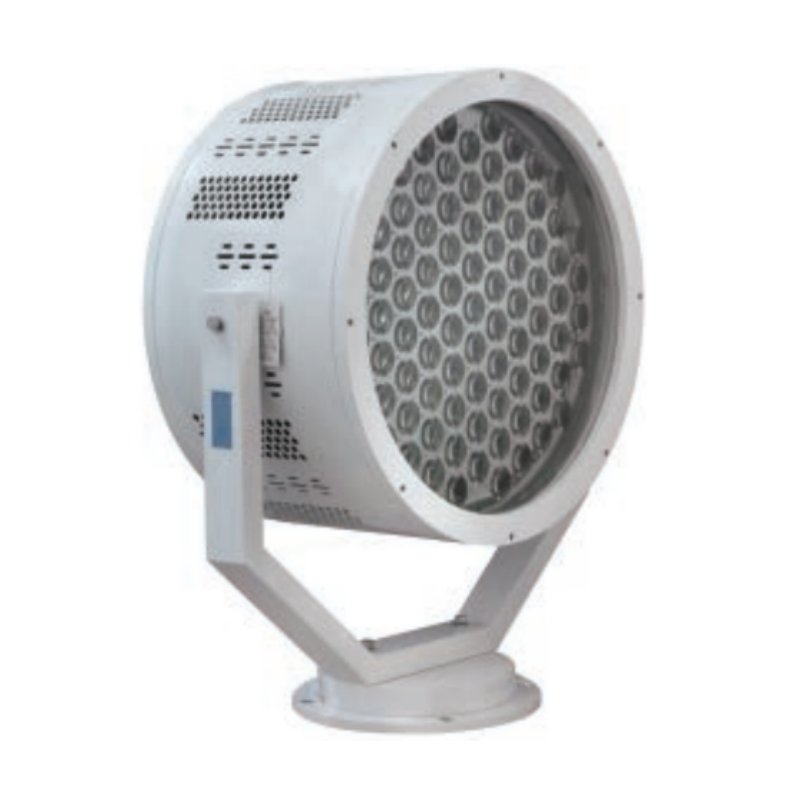
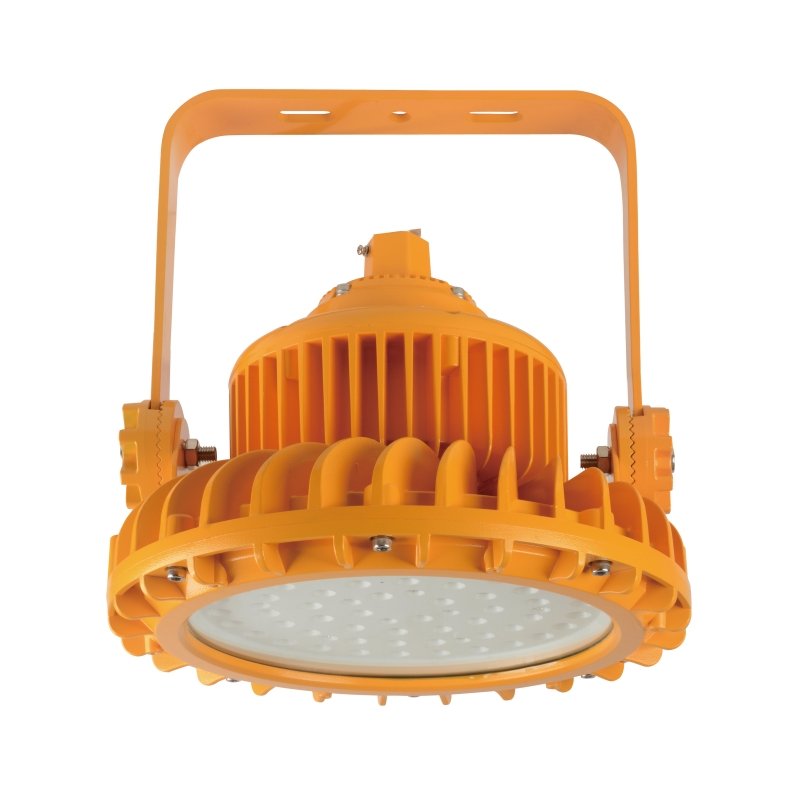
When writing technical specifications, start with a hazardous area classification drawing rather than a product catalogue. This avoids most conflicts. For Zone 1 and Zone 2 marine explosion-proof light, purchasers can then select products directly from the drawings based on the hazardous area classification and explosion protection type – without repeatedly translating between the ATEX and IECEx certification systems.
Where ATEX Still Binds a Supply Chain
Fixed offshore facilities are not excluded from the scope of ATEX. ATEX applies to fixed platforms, onshore storage tank areas, loading docks and shipyard paint shops. For equipment placed on the EU market for these purposes, the CE marking route must be followed, regardless of how similar equipment on board vessels is classified.
As a result, many shipyards prepare two sets of technical specifications in parallel. Lamps installed on fixed jacket platforms may require ATEX certification, while identical lamps on shuttle tankers moored alongside do not. Teams that treat the two as the same procurement item often only discover this difference at the document review stage.
Zone, EPL and Protection Type: The Selection Chain for Marine EX Lighting
The hazardous area is the starting point for all subsequent selection. According to IEC 60092-502, the cargo oil pump room and the area within 3 metres of a cargo oil tank vent are classified as Zone 1, requiring equipment with EPL Gb – for example, flameproof Ex db, increased safety Ex eb, or intrinsically safe Ex ib luminaires. In November 2025, The Maritime Executive listed these boundaries in a technical paper on hazardous area classification for ships.
| Zone | Typical shipboard location | Required EPL | Luminaire protection types accepted |
|---|---|---|---|
| Zone 0 | Cargo tank interiors, slop tanks | Ga | Ex ia only (portable inspection lighting) |
| Zone 1 | Cargo pump rooms, within 3 m of vent outlets, cofferdams, manifold areas | Gb | Ex db, Ex eb, Ex ib, Ex mb, Ex pxb |
| Zone 2 | Within ~10 m horizontally of vent outlets, deck areas above cargo tanks, paint stores | Gc | Ex ec, Ex ic, Ex mc, Ex pzc |
| Non-hazardous | Accommodation, wheelhouse, machinery spaces outside fuel prep rooms | n/a | Standard marine-grade IP-rated fittings |
Typical examples – exact hazardous-area boundaries must be confirmed against the vessel’s approved hazardous-area classification drawing. The table shows typical IEC 60092-502 boundaries only.
Determining the hazardous area alone is not enough to complete the selection. The gas group and temperature class must also be considered to finalise the specification. Luminaires marked IIB are not suitable for locations where hydrogen may be present, and liquefied gas carriers with complex cargo lists usually require the IIC gas group. The temperature class is determined by the maximum surface temperature of the luminaire, with the ignition temperature of the cargo as the upper limit.
Neither ATEX nor IECEx can change these physical limitations, because both are based on the same set of IEC 60079 test methods. The real difference between the two systems is the certificate attached to the luminaire, not the flame path machined into the enclosure.
Complete information can be obtained by reading the marking sequence in order. For example, Ex db IIB T4 Gb means: flameproof enclosure, gas group IIB, maximum surface temperature limit of 135 °C, and EPL Gb, which is suitable for Zone 1. Focusing only on the first two characters is often why incorrectly matched luminaires end up installed on deck.
Salt spray, vibration and washing will further narrow the available options. A 316L stainless steel marine floodlight specified for the cargo oil manifold area must maintain its flameproof joint tolerances after years of chloride attack – a material issue, not a certification issue.
Flag State Divergence: Why US-Flag Tankers Reject ATEX-Only Luminaires
US-flagged vessels do not accept equipment that holds only ATEX certification. The U.S. Coast Guard (USCG) has stated in Ship Inspection Notice 01-12 that equipment certified under the ATEX Directive does not meet the requirements of 46 CFR 111.105-7(a) and must either be replaced or accompanied by proof that the testing was performed by an independent laboratory accepted by the USCG. Policy letter CG-ENG 01-13 reiterates the same position for offshore installations.
The reason is procedural rather than technical. ATEX allows manufacturers to self-certify Category 3 equipment intended for Zone 2, whereas the Coast Guard requires testing to be supervised by an independent laboratory. Since both systems are based on the same IEC 60079 tests, the same product usually only needs an additional report from an accredited laboratory to comply.
Documentation is as important as hardware. Under 46 CFR 110.25-1, vessels with hazardous areas must maintain drawings showing the extent of each classified area and the type of equipment installed, supported by either an independent laboratory test certificate or an IECEx Certificate of Conformity (CoC).
Enforcement pressure can be quantified. In its 2025 Annual Report, released on 1 July 2026, the Paris MoU recorded 16,474 inspections, 51,797 deficiencies and 688 detentions, including 646 deficiencies related to general electrical installations. Flag state administrations have also strengthened their oversight accordingly.
Personnel qualification requirements are equally clear. In July 2025, the Liberian Ship Registry issued Maritime Notice 12/2025 Revision 1, reminding operators that only properly trained personnel may inspect and maintain certified explosion-protected electrical installations on tankers, liquefied gas carriers and ships to which the IGF Code applies. A correct marine navigation and deck lighting selection guide helps crews avoid mistakenly replacing certified light sources with non-certified ones during routine maintenance.
Building the Certificate Stack Marine Procurement Actually Needs
You need four documents, not one. A Zone 1 marine luminaire typically requires an IECEx Certificate of Conformity, classification society type approval, marine environmental test report, and an ATEX certificate only if the same product is also placed on the EU market. According to IECEx, the system has more than 60 accredited certification bodies (ExCBs) in over 35 countries.
| Criterion | ATEX | IECEx |
|---|---|---|
| Legal nature | EU law, mandatory for EEA market placement | Voluntary international scheme under IEC |
| Applies to shipboard equipment? | No, excluded by Art. 1(2)(e) | Yes, the expected route |
| Issuing body | Notified Body (ExNB) | Certification Body (ExCB) |
| Output document | EU Type Examination Certificate | Certificate of Conformity (CoC) |
| Self-certification allowed | Yes, Category 3 (Zone 2/22) | No |
| Ongoing factory surveillance | Via QA notification | Mandatory QAR audits |
| Accepted on US-flag vessels | No (USCG MIN 01-12) | Yes (46 CFR 110.25-1) |
| Public certificate database | No central register | Yes, IECEx online certificate system |
The sequence of certification has commercial implications. IECEx’s test report (ExTR) and quality assessment report (QAR) can support subsequent ATEX applications, while ATEX reports cannot be used to support IECEx applications. Therefore, manufacturers targeting both marine and onshore markets usually obtain IECEx first and then add ATEX as a follow-up.
After this clarification, ATEX vs IECEx is no longer an either/or choice but a question of sequence: first obtain the certification with the widest scope of application, then add regional certificates for markets where they are legally required.
Classification society type approval is a completely different set of certificates. According to the IEC 60068 series, DNV, ABS, Lloyd’s Register (LR), Bureau Veritas (BV) and China Classification Society (CCS) verify marine suitability through vibration, inclination and temperature tests. An IECEx certificate cannot demonstrate whether a luminaire can operate normally at a 22.5-degree heel.
Ingress protection requirements are also part of the stack. Open-deck luminaires in cargo areas are usually specified with IP66 or IP67 ratings to withstand waves and high-pressure washing. The ingress protection rating must ensure that the enclosure itself can withstand the same salt spray exposure.
Demand for this certificate stack continues to grow. DNV’s Alternative Fuels Insight platform recorded 137 orders for alternative-fuelled ships in the first half of 2026, of which 73 were LNG-fuelled. Every ship subject to the IGF Code will have additional hazardous areas, such as bunkering stations and fuel preparation rooms, that require certified lighting.
Write the certificate stack into the purchase order rather than chasing it at commissioning. Requesting the IECEx CoC number, the class type approval certificate and the ingress protection test report alongside the marine electrical equipment enquiry form turns three separate document hunts into one.
FAQ
No, it does not. Directive 2014/34/EU, Article 1(2)(e), excludes seagoing vessels and mobile offshore units and their onboard equipment because the IMO Convention covers the relevant risks. An ATEX certificate is not required for marine lamps, but if one is held, classification society surveyors will still evaluate the installation in accordance with IEC 60092-502 and IEC 60079.
Yes, for onboard equipment, IECEx certification is acceptable and is the expected certification route. However, IECEx cannot replace ATEX for equipment placed on the EU market for fixed offshore installations or onshore use. The IECEx Test Report (ExTR) and Quality Assessment Report (QAR) can support an ATEX application, which is why manufacturers often obtain IECEx certification first and then apply for ATEX.
Yes. According to 46 CFR 110.25-1, hazardous area drawings may be supported by an IECEx Compliance Certificate or an Independent Laboratory Test Certificate. Ship Inspection Notice 01-12 gives the opposite conclusion for ATEX-certified equipment: equipment with only ATEX certification does not meet 46 CFR 111.105-7(a) and must be replaced or retested.
According to IEC 60092-502, the cargo pump room and areas within 3 meters of cargo oil tank vents are classified as Zone 1, and Gb-rated equipment is required. Areas within approximately 10 meters of the vent outlet are classified as Zone 2, where Gc-rated luminaires such as Ex ec may be used. The exact extent must be determined from the approved hazardous area classification drawing.
No. The two certifications address different requirements. IECEx certification confirms that equipment meets explosion protection requirements according to IEC 60079, while classification society type approval (e.g., DNV, ABS, LR, BV, CCS) confirms marine suitability through vibration, inclination, and temperature tests based on IEC 60068. Classed vessels generally require both certificates; equipment with only one of them is usually not accepted.
Conclusion
The ATEX vs IECEx comparison leads to different conclusions at sea and on land. Because ATEX Directive 2014/34/EU excludes seagoing vessels and their onboard equipment, the accepted certification combination for marine lighting is IECEx certification plus classification society type approval. ATEX still applies to fixed offshore facilities and to products placed on the EU market. The differences also extend to flag state rules: U.S.-flagged vessels may outright reject ATEX-certified equipment. The hazardous area should be classified first, and then the appropriate certification combination should be selected.