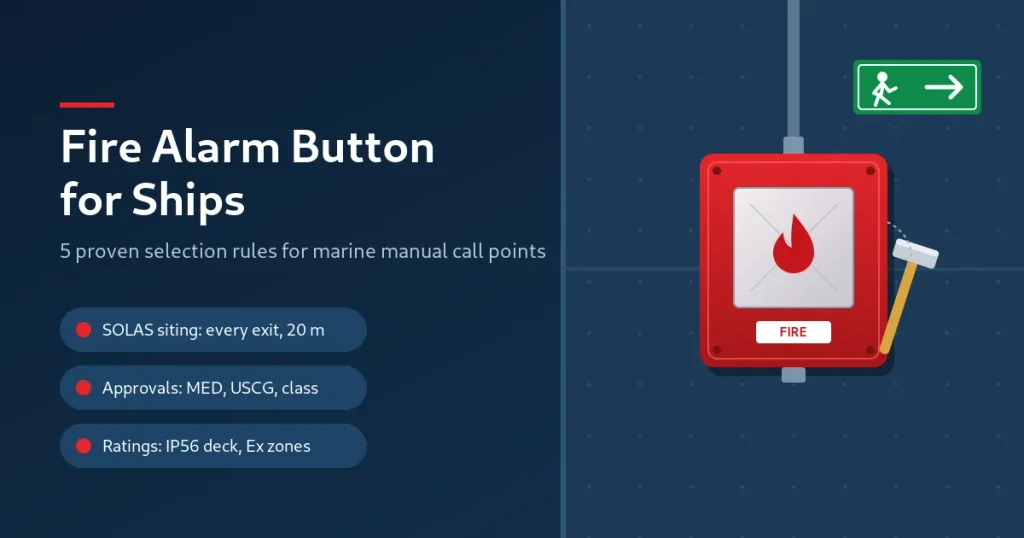
A fire alarm button, also called a manual call point, is a switch installed on the wall. The crew can raise a fire alarm by breaking or pressing the fragile element. On SOLAS ships, one exit must be provided at each exit of the accommodation, service premises and control station, and the nearest button must not exceed 20 m from any position in the corridor.
Is the red box by your mess room door approved for the panel it feeds? Would it survive green water on the weather deck? Choosing a fire alarm button for a ship is harder than it looks. Building products, marine loop devices and heavy-duty contact alarm boxes are similar in appearance, but the applicable rules are different.
Where SOLAS Requires a Fire Alarm Button on Board
SOLAS Chapter II-2, Regulation 7.7 requires the manually operated call point to be fully set up in living accommodation, service premises and control stations: one at each exit and no more than 20 m from the button at any point in the corridor. In 2026, the Paris MoU’s 2025 Annual Report shows that fire safety still accounts for 16.8% of all port state deficiencies.
These rules apply based on space type rather than ship size, so coastal tankers and cruise ships follow the same set of layout requirements. Common problems often appear in the control station: the emergency generator room does not set the manual alarm button, which also is a typical defect in the inspection; U.S. rule in 46 CFR 76.27-70 (b) also explicitly includes control stations in the scope of protection.
Sections, Zones and Individual Identification
If the system cannot identify each device individually, FSS Code Chapter 9 limits the size of each section. According to 46 CFR 76.27-70 (h), in a non-addressed system, a section consisting of a detector and a manual call point may not cover more than 25 enclosed spacers. Passenger ships carry a stricter duty: each detector and call point must be remotely and individually identified.
In practice, the choice of call point depends primarily on the type of fire alarm control panel. If the panel is addressable, the call point must speak its protocol. If it is conventional, the button adopts a normally open contact, which is usually connected to a certain detection area through an alarm resistor. FAA Code Chapter 9 also requires the call to access the dedicated detection section, which cannot be shared with other alarm circuits.
For more information on ship safety, please refer to our marine electrical safety guides.
Manual Call Point Types: Break Glass, Resetable, and Contact Types
EN 54-11 stipulates two types of operation: Type A can trigger the alarm directly by crushing or pressing the front panel element; Type B requires a second deliberate action to trigger the alarm. In 2026, the EU Implementing Regulation 2026/1434 continued to list the manual call point under MED/3.51f, which sets out the wheelmark test requirements for marine products.
Type A dominates at the sea, because crew may wear gloves or be in the smoke. The choice between glass and plastic components is mainly a maintenance issue. Glass can clearly show whether it has been acted on. However, whether it is a real alarm or a false touch when each action, it is necessary to replace the spare components and clean up the debris.
| Type | How it operates | Typical marine use | Watch-outs |
|---|---|---|---|
| Break glass call point (EN 54-11 Type A) | Glass breaks, switch closes, panel registers the zone or address | Accommodation, corridors, control stations | Stock spare glass; confirm panel compatibility |
| Resettable-element call point | Plastic element flips; reset with a key | Galleys, high-traffic passageways, washdown areas | Activation flag must stay visible until reset |
| Heavy-duty contact break-glass box | Hammer breaks glass; contacts switch the alarm circuit directly | Conventional bell circuits, workboats, retrofits | Confirm flag and class acceptance before use on a detection loop |
| General emergency alarm push button | Maintained switch for the muster signal | Bridge, engine control room | Not a fire call point; separate system |
Why a Marine Fire Alarm Push Button is Not the General Alarm
Both of them are red in appearance and will sound an alarm, but they belong to different circuits. The general emergency alarm sounds seven short and one long to call the crew to the muster stations; the fire call point reports the location to the detection panel. Mixing that will make the crews confused and inspection fail.
For conventional hard-wired circuits, the steel IP56 marine fire warning button rated 250 V/10 A is suitable for exposed passageways and machinery flats, which comes with a hammer and a single cable gland. As it is a contact device, not an EN 54-11 loop device, please confirm acceptance with the flag State administration or classification society before connecting it to a SOLAS detection loop.
How to Select a Marine Manual Call Point: 5 Rules
First, confirm the flag requirements. EU-flagged vessels need to use products with steering wheel marks; US-flagged vessels are required to use equipment approved under 46 CFR 161.002, which refers to UL 38 as the manual signaling boxes standard. The current eCFR text (2026) also sets IP56 as the minimum protection level for fire detection junction boxes under 46 CFR 113.10, a reasonable benchmark.
Once the approval route is clear, the other four rules are easy to determine. Use the following table as a purchase checklist.
| # | Rule | What to check | Why it matters |
|---|---|---|---|
| 1 | Approval matches flag | MED/3.51f wheelmark, USCG 161.002 approval, or class type approval | Uncertified units are a detention risk |
| 2 | Panel compatibility | Conventional alarm resistor value or addressable protocol | A mismatch gives a fault or no alarm at all |
| 3 | Ingress rating | IP56 minimum on open decks; IP66 or IP67 in washdown zones | Salt spray and green water attack contacts |
| 4 | Hazardous area | Ex d or Ex ia marking for the zone | A normal switch can ignite gas |
| 5 | Mechanical build | Steel or GRP enclosure, gland size versus cable OD, spare glass and keys | Vibration and corrosion loosen cheap housings |
The call point that does not match its panel protocol is not a spare part. It is a defect in the fire zone.
Explosion-Proof Fire Alarm Button for Hazardous Zones
Between oil tankers, LPG tankers and paint, buttons are usually located in classified zones. EN 54-11 is not applicable here because its scope explicitly excludes products used in hazardous environments. You need to choose explosion-proof products.
Please select a flameproof or intrinsically safe unit with its own certificates for the area, and the principle for selecting explosion-proof makings are the same as those described in our article on how marine explosion-proof lighting works.
Installing and Testing Marine Fire Alarm Button
IMO guideline MSC.1/Circ.1432 requires monthly sampling of test detectors and manual call points to ensure that each device is tested at least once within five years. The risks remain high: in 2026, Allianz Commercial’s Safety and Shipping Review counted more than 200 vessel fires in 2025, the second-highest number in a decade.
Each button should be installed in a visible position on the escape route and can be touched without crossing the device. The operation mode of the whole ship button should be consistent. Personnel should not be required to temporarily adapt to new operating mechanisms in smoke-filled corridors.
The alarm effect of the manual alarm button depends on the alarm device it starts. If the bridge does not confirm the manual alarm signal within two minutes, FSS Code Chapter 9 requires that the alarm be automatically extended to crew accommodation, service spaces, control stations and category A machinery spaces. For conventional circuits in the cabin with large noise, the button can be used with the 92 dB DC/AC marine alarm bell rated IP56.
The recommended daily process is as follows:
- Monthly: Use the test key to test a rotating sample of buttons and confirm that the controller indicates the correct section or address.
- After any activation: Replace the glass or reset element, and log the event.
- Annually: Run a full system test. On US vessels, 46 CFR 76.27-70 (a) folds this into the annual inspection.
Conclusion
The fire alarm button on a ship is a device subject to regulations and cannot be used as an ordinary switch. Each exit must have a call point, and no point in the corridor may be more than 20 m from one. Product approval must match the flag State requirements, the electrical characteristics must be compatible with the alarm control panel, and the enclosure protection rating must suit the deck environment where it is installed. Then test a sample every month. For conventional circuits, Bozhou Marine provides IP56 steel break-glass fire warning buttons and supporting marine alarm bells.
FAQ
SOLAS calls it the manually operated call point, commonly referred to as MCP or call point by crew members. U.S. regulations use a third name: 46 CFR 161.002 to include “manual fire alarm boxes” as part of an approved manual fire alarm system. The three names refer to the same function, that is, the switch that sends a fire signal to the detection controller.
Both of them usually belong to EN 54-11 Type A, and the alarm can be triggered in one action. The difference is in the element: the glass must be replaced after each use, and the resettable plastic components can be restored with a key for a few seconds. EN 54-11:2001 and its amendment A1:2005 cover both designs, so they have the same compliance.
SOLAS sets two conditions, not a fixed spacing. A call point must be set at each exit of the accommodation, service and control spaces. In addition, no position in the corridor should be more than 20 m from a call point; in longer corridors, this usually means additional call points must be installed between exits.
Yes, provided that its enclosure protection rating can resist splashing and water ingress. U.S. regulation 46 CFR 113.10 requires fire detection junction boxes to meet IP56, which is also a reasonable minimum for any outdoor call point. For washdown areas and open decks subject to wave impact, choose IP66 or IP67 products with suitable cable glands.
According to MSC.1/Circ.1432, a sample of detectors and manual call points should be tested monthly, ensuring that each device is tested at least once within five years. The entire system should also be function-tested annually. For ships flying the U.S. flag, 46 CFR 76.27-70(a) incorporates this annual test into the Coast Guard inspection.
Yes, for ships flying the flag of an EU Member State. Manual call points fall under MED/3.51f. As of 31 August 2026, the current testing requirements are set out in EU Implementing Regulation 2026/1434. The wheelmark indicates that the design has been reviewed by a notified body. Ships under other flags rely on USCG approval or classification society type approval.
The fire alarm control panel on the bridge raises an alarm and displays the section; an addressable system shows the specific device. If the alarm is not acknowledged within two minutes, Chapter 9 of the FSS Code requires the alarm to be automatically propagated to accommodation spaces, service spaces, control stations, and Class A machinery spaces.