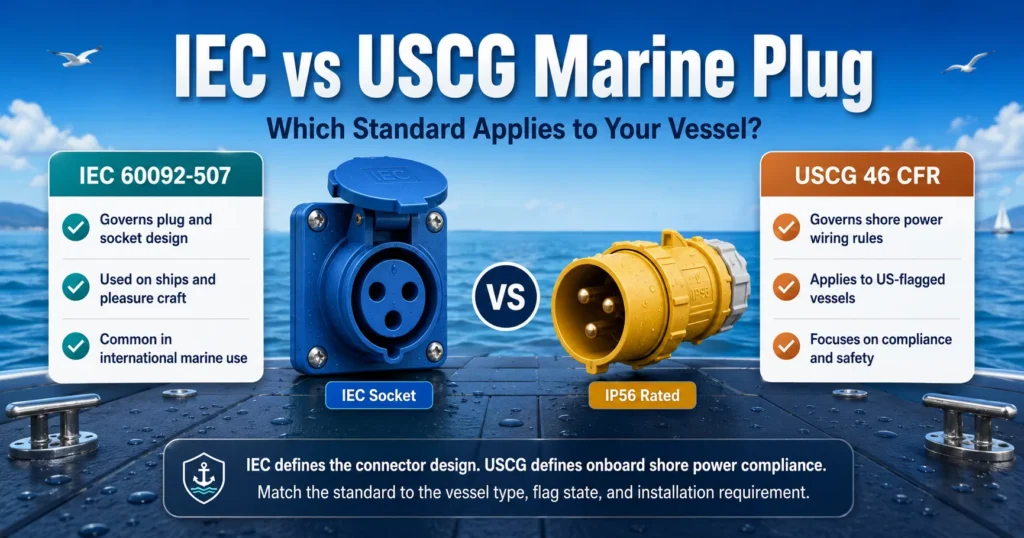
Have you ever had trouble answering a surveyor’s question “which criterion does this meet” when choosing marine watertight plugs for charter vessels in the US? The reason why IEC vs USCG marine plug puzzles the purchaser is that these two sets of files specify different links for the same connection point: one sets manufacturing requirements for the marine plugs, and the other sets electrical connection methods.
What Does IEC 60092-507 Require for Marine Plugs?
According to the current version of the International Electrotechnical Commission, IEC 60092-507 stipulates the design rules for marine plugs, sockets and connectors used in small ships with a length of no more than 50 meters or a gross tonnage (GT) of no more than 500 tons. Under this standard, the upper voltage limit of the yacht AC system is 250V for single-phase and 500V for three-phase, and the upper voltage limit of the DC system is 50V.
The standard makes clear provisions on contact spacing, mechanical keying (physical anti-stale design between plugs and sockets to prevent mis-insertion of different specifications) and insulation, ensuring that marine plugs and sockets produced by different manufacturers can be safely plugged even if they are separated for many years. However, the standard itself does not specify how shore power outlets should be connected to the ship’s switchboard, nor does it specify which breaker should protect the circuit.
When purchasing marine watertight plugs, it is recommended to verify the IEC edition number marked on the marine plug before placing an order, as the pin spacing may be slightly different for older versions. Pay attention to the purchaser of marine watertight plug standards, and ensure that the version numbers used at both ends of the connection are consistent.
Leisure boats of less than 24 metres in length and in compliance with the EU Recreational Craft Directive are partially exempt from the requirements of IEC 60092-507, except for three-phase systems with voltages exceeding 500V. This makes small sailboats and large three-phase yachts need to follow different compliance paths.
Read the related article: IMPA Code Marine Electrical Connector Complete Reference for more details
What Do USCG 46 CFR Shore Power Rules Cover?
The USCG shore power regulation, that is, 46 CFR 183.390 and parallel 120.390 clauses, requires that the ship’s electrical system with a voltage exceeding 50V must be permanently installed with a shore power connection box, special cables and circuit breakers. These regulations refer to the installation method, not to the shape of the plug itself or the IP protection level.
The regulation also requires the interlock function between the shore power circuit breaker and the ship’s own power supply to prevent the shore power and the ship-borne generator from supplying power to the switchboard at the same time, so as to avoid the simultaneous access of two power supplies. This does not specify the number of pins count, contact material or IP grade of the socket.
Therefore, while meeting the USCG wiring requirements, the shipyard also needs to select an IEC-rated marine plug to meet the requirements of both installation regulations and connector physical design. Passenger ships subject to inspection in accordance with Chapter K or Chapter T of 46 CFR shall follow the same shore power wiring regulations; the larger ships inspected according to the J sub-chapter may also need to be reviewed by the Marine Safety Center before the high voltage shore connection (HVSC) is put into use.
The lack of any of these steps will bring actual risks: a marine plug that meets IEC 60092-507 will still be unqualified during USCG ship inspection if it is equipped with a circuit breaker line without interlocking function; on the contrary, a well-installed circuit breaker box, if equipped with a home-grade plug, it is likely to fail in a wet deck environment for less than one season.
How Do IEC and USCG Rules Apply on the Same Vessel?
American small passenger ships usually adopt the following methods to deal with the application of IEC vs USCG marine plug: permanent installation of shore power box according to 46 CFR 183.390, and plugs conforming to IEC 60092-507 or IEC 60309 standard at the end. The two sets of standards are aimed at the same connection point, but the specifications are at different levels: one is the regulatory level, and the other is the mechanical design level.
USCG regulations mainly confirm whether the wiring is installed correctly, while IEC standards mainly confirm whether the plug itself meets the requirements of marine construction. When inspecting ships based on 46 CFR, surveyors focus on circuit breaker interlocks and cable routing, rather than pin geometry, unless the classification society requires the use of an IEC-marked connector.
Comparison between IEC 60092-507 and USCG 46 CFR:
| Aspect | IEC 60092-507 | USCG 46 CFR (183.390 / 120.390) |
|---|---|---|
| What it governs | Plug, socket and coupler design | Shore power wiring installation |
| Issuing body | International Electrotechnical Commission | US Coast Guard |
| Applies to | Ships and pleasure craft up to 50m / 500 GT | US-flagged vessels above 50V systems |
| Typical rating | 16A/20A, 2P+E or 3P+E | Not connector-specific |
| Covers IP rating | Yes, via related IEC parts | No |
Common Marine Plug Pin Configurations
The common configuration of the marine plug is as follows: the single-phase 16A or 20A circuit adopts 2P + E (two poles plus grounding, that is, Pole pole + Earth grounding) configuration, and the three-phase circuit adopts 3P + E configuration with the same current level. For the three-phase neutral line system of large ships, the marine plug pin configuration will also be extended to variants such as 4P + E and 5-pin.
The color coding is usually blue for single-phase and red for three-phase, which helps the crew to avoid misconnection of incompatible circuits when installing marine electrical connectors. The common voltage range of the cabin connector is 100V-130V to 380V-460V. Checking the color and voltage identification before plugging can avoid damaging the shipboard equipment due to the mismatch of specifications.
What IP56 Rating Means for a Marine Watertight Plug
The IP56 marine plug prevents harmful dust from entering and withstands the impact of powerful water jets from a 12.5mm-diameter nozzle at a distance of 2.5 to 3 meters. This IP rating does not apply to full submersion scenarios, which requires special attention when determining the deck installation location.
The first digit “5” indicates that the shell is dust-protected, but not completely dust-tight (this level belongs to a higher level of IP6X).
The second digit number “6” confirms that the plug can withstand powerful water jets and is suitable for installation in open deck areas that often come into contact with flushing hoses and rainwater, but is not suitable for bilge areas that are prone to water accumulation.
If the marine connector is installed below the waterline or is at risk of periodic flooding, marine watertight sockets of IP67 or IP68 grade are usually required, as the IP56 marine plug is designed to respond to spray rather than immersion.
Brass or Plastic: Which Marine Plug Body Lasts Longer?
Plug housings made of high-impact plastics such as nylon or PA66 (a high-strength engineering plastic) are resistant to ultraviolet (UV) and chemical corrosion. Brass contacts treated with tin, nickel or gold plating can resist galvanic corrosion (galvanic corrosion, that is, the corrosion reaction of different metals in the electrolyte environment) that is easy to occur in bare brass in seawater.
When comparing brass vs plastic marine plug, the coating process is often more critical than the substrate itself.
The bare brass shell without coating treatment has a faster corrosion rate than the nylon shell in the salt spray environment. Therefore, most of the marine plugs use plastic or nylon as the shell, and the conductive pin part uses metal. Nylon fittings should not be installed below the waterline, and this principle is also applicable to electrical enclosures installed in similar wet environments.
Tin-plated or nickel-plated brass contacts combined with silicone O-rings in UV-resistant nylon housings are a better combination of brass vs plastic marine plug for most deck and cabin installation scenarios. Direct contact of different bare metals in salt spray environments is still the most common cause of premature failure of marine connectors.
FAQ
Not required. Because USCG 46 CFR 183.390 stipulates the wiring and protection mode of shore power connection, it does not involve the physical design of the marine plug, and does not limit the number of pins or IP level. Shipyards usually choose marine plugs that meet IEC 60092-507 or IEC 60309 standards to meet the requirements of marine structures.
IEC 60309 covers industrial-grade pin and sleeve connectors used in various industries, including shipyards, while IEC 60092-507 is dedicated to the electrical installation of small ships and yachts up to 50 metres in length. Ship purchasers often see these two standards cited side by side in the same marine connector data table.
Most marine plugs adopt 2P + E configuration in single-phase circuit and 3P + E configuration in three-phase circuit. The common current level is 16A or 20A. Blue represents single-phase and red represents three-phase color coding, which helps the crew to quickly identify the correct socket during shore power docking.
The uncoated bare brass is corroded faster than the nylon shell in seawater, but the coated brass contacts installed in the nylon or PA66 shell have good corrosion resistance. Recent technical guidelines for connector manufacturers suggest that tin-plated, nickel-plated or gold-plated brass contacts should be selected for marine scenarios, and UV-resistant plastic shells should be used.
IEC 60092-507 stipulates that for yachts with a length of no more than 50 meters or a total tonnage of no more than 500 tons, the upper limit of single-phase voltage of the AC system is 250V, the upper limit of three-phase voltage is 500V, and the upper limit of DC system voltage is 50V.
Conclusion
The difference between IEC and USCG marine plugs is that IEC 60092-507 and related IEC plug standards stipulate the manufacturing requirements of the marine plug itself, while USCG 46 CFR stipulates the installation method of shore power connection on American ships.
Most compliance solutions meet two sets of standards at the same time: a shore box with permanent wiring, and a nylon housing plug with IEC markings, IP56 or higher, and coated contacts at the end.
Verifying the two standards at the same time before placing an order, rather than waiting for the ship to find the problem after the inspection, which can avoid rework, so that the ship shore power system can maintain compliance in both regulations and mechanical design.
For more details, read Marine Electrical Connector: 7 Essential Tips for Maximum Safety.