When selecting yacht light, three factors need to be matched at the same time: lighting area, power supply system and use of the environment in the boat. It is recommended to use 12V/24V LED cabin lights in the indoor area. The IP67 waterproof light is recommended for the humid external area; night navigation must use standard navigation lights. The comfortable lighting in the cabin can choose 3000 K warm white light, and the task lighting can choose higher brightness white light.
Are you choosing yacht light for cabins, decks, cockpits, stairs or RV-style ceilings? Is your primary need for comfort, safety or waterproof performance? Yacht lighting is usually used in small spaces and exposed to humid air, salt fog and low-voltage power supply systems. The wrong light may cause glare, excessive battery consumption or premature failure.
How to Choose Yacht Light: Safety first
Before choosing Yacht Lighting, you should distinguish safe lighting and comfortable lighting. Navigation lights are different from cabin lights, courtesy lights, porch lights or underwater lights. The function of the navigation light is to indicate the course, hull size and motion state to other ships; yacht light is mainly used for reading, cooking, passing and cabin rest.
For yachts used at night, the most basic principle is to avoid confusion between indoor lights or decorative lights and navigation lights. Red and green sidelights have clear legal implications. Masthead light, sternlight and all-round light also have specific illumination angles and visible distances. Therefore, if too bright RGB decorative lights are installed near the bow, guardrail or deck edge, it may interfere with the identification of navigation lights by other ships, resulting in safety risks.
For most buyers, the practical choice is: to buy qualified navigation lights in areas related to navigation safety; for cabin comfort lighting, stair lighting, deck traffic lighting and external atmosphere lighting, appropriate yacht lights should be selected respectively. In the planning of yacht lighting, the yacht can be divided into 5 lighting areas:
- Cabin and salon area: use soft light, low glare ceiling light or tube light.
- Kitchen and chart table: use brighter, more color-stable task lighting.
- Stairs and passages: use courtesy light installed low.
- Deck, cockpit and porch area: use waterproof external lights.
- Navigation area: use red port lights, green port lights, white mast lights, stern lights and anchor lights that meet the specifications.
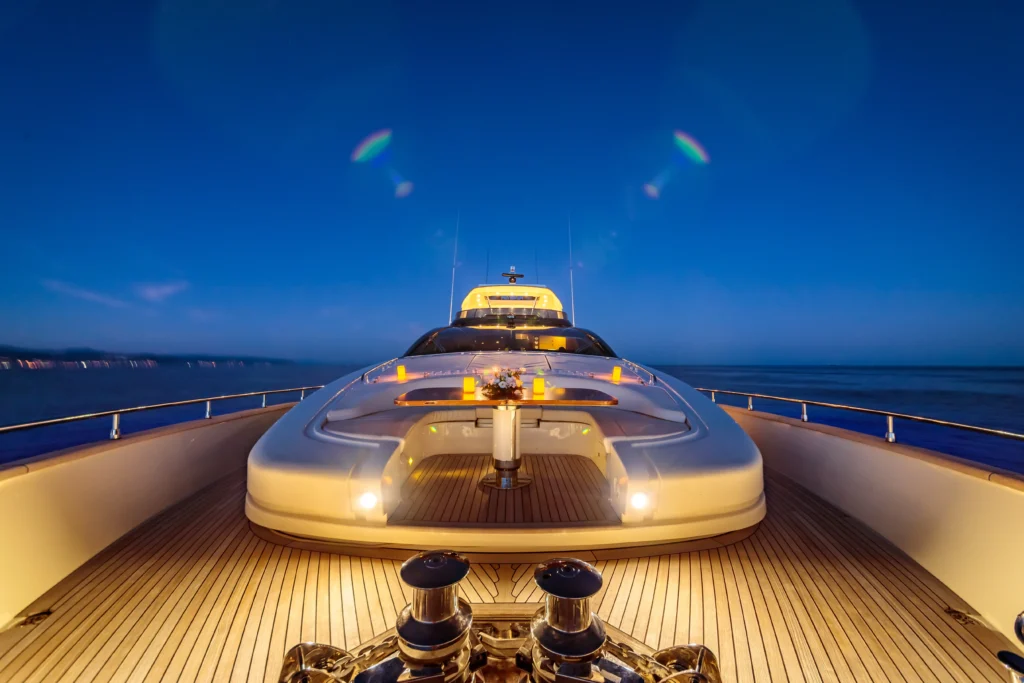
Yacht Lighting: Matching Beam Angle, Color Temperature and Voltage
Since the cabin space is usually small, and the walls, ceilings and furniture are easily reflective, the most suitable yacht light for indoor use is not necessarily the light with the highest brightness. High-quality cabin lights should provide sufficient illumination while avoiding dazzling glare. For sleeping quarters, lounge areas and dining areas, a warm white light of about 3000K is usually more comfortable; for the operating area and the working area, the cold white light of about 6000 K can make the details clearer, but if the whole cabin uses cold white light, the light may appear stiff and dazzling.
Bozhou Marine’s 12V/24V yacht and RV LED downlight BZDL11 are suitable for compact ceiling or embedded installations. This product uses an aluminum light body, provides 3000K and 6000K LED color temperature options, irradiation angle is less than 30 °, power can choose 1W to 9W. Therefore, it is suitable for local key lighting, such as small cabins, berths, cabinet areas or reading areas.
If a larger range of cabin lighting is required, Bozhou Marine’s BZDL12 downlight provides an illumination angle greater than 60 °, and the power can be selected from 3W to 18W. The light is more suitable for the basic lighting of salon area, dining area or larger yacht indoor space.
Surface mounted RV marine ceiling light BZTH01 is an affordable choice. It uses ABS and PC materials, the operating voltage is DC11V-18V, provides 3.6W or 6W power options, and is equipped with a touch switch. This light is suitable for RVs, small yachts, cabins, truck cockpits, and compact marine interior spaces, especially in situations where it is not easy to open large holes for embedded installation.
Simple yacht light selection rules:
- The narrow beam tube light – mainly for the key lighting area.
- The wide beam tube light – mainly for ordinary cabin lighting.
- When it is inconvenient to open holes, the surface mounted ceiling lamp is more suitable.
- Warm white light is used in the cabin rest area, and white or cold white light is used in the working area.
- Confirm the ship voltage before placing the order: 12V, 24V or wide voltage input.
RV Marine Ceiling Light: Why 12V / 24V LED lights can Reduce Battery Burden

RV and yacht indoor lighting face many common needs: compact space, DC power supply, low ceiling height, vibration and limited battery capacity. Therefore, 12V and 24V LED ceiling lights are commonly used in ships, yachts, motorhomes, campervans and trailer interiors.
LED lights are usually more suitable for indoor use in yachts than incandescent lights because of their lower energy consumption and less heat. Low power consumption is important on yachts because cabin lights can be turned on for hours on end and ships rely on battery power. Low calorific value is also important because compact cabins usually have limited ventilation conditions.
Check the following five details before place an order:
- Voltage compatibility: 12V systems are commonly used in small ships and RVs, and 24V systems are more common than large ships.
- Switch types: touch switch, external switch, PIR human body induction switch or pressing switch.
- Installation method: embedded downlight or surface mounted ceiling light.
- Protection level: indoor lights can use a lower IP level, and external lights need a higher protection level.
- Color temperature selection: warm light is used in the living area, and white light is used in the working or tool area.
Also pay special attention to: unless the waterproof grade and shell material of the product are suitable for the humid external environment, the comfortable indoor ceiling light should not be installed in the humid external position. The cabin ceiling light and the waterproof porch light may appear similar in the picture, but their working environments are completely different.
Waterproof Yacht Light Selection: IP Rating, Mounting Position and Glare Control
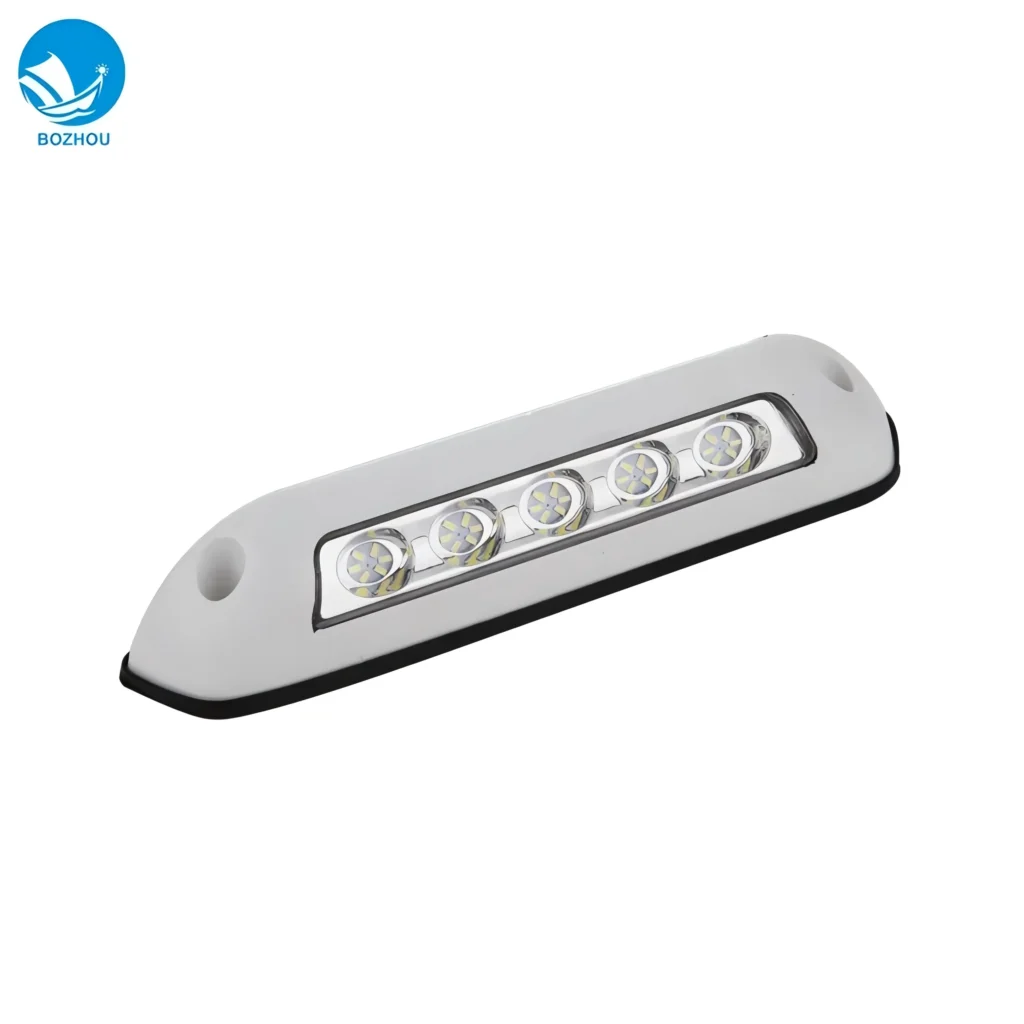
External yacht lighting must be able to withstand rain, flushing water, waves, moist air, ultraviolet light and vibration. For the external area, IP protection level is an important index to quickly compare the protection ability of lamps. IP67 usually indicates that the light has dustproof sealing ability and can resist short-term immersion. For underwater lights or long-term immersion lights, buyers should not simply assume that all IP68 products have the same performance, but should view the specific test depth and test time marked by the manufacturer.
For stairs, cockpits, passageways and courtesy lighting, low mounting is usually more appropriate than high light at eye level. Low-level lighting can guide people to move without affecting the night vision. The ambient light should be as low as possible, indirect exposure, and avoid direct glare. This is particularly important when people move from the cabin to the deck at night.
| Use Case | Recommended Product Type | Why It Fits | Use Case |
|---|---|---|---|
| Small cabin or berth | Narrow-beam yacht LED downlight | 3000K/6000K, 1W–9W, compact recessed sizes | Small cabin or berth |
| Larger saloon or cabin | Wide-beam yacht LED downlight | Over 60° beam angle, 3W–18W options | Larger saloon or cabin |
| RV/yacht ceiling | Surface-mounted ceiling light | DC11V–18V, touch switch, 3.6W/6W | RV/yacht ceiling |
| Exterior entry or porch | Waterproof porch light | IP67, 800LM, PIR/external/touch switch | Exterior entry or porch |
| Step or walkway | Courtesy light | IP67, 12V, 0.2W, low-level guide light | Step or walkway |
| Handrail area | Handrail light | 10–30V, 1W, compact guide lighting | Handrail area |
Conclusion
When you choose Yacht Light, you should not only focus on brightness. The correct approach is to first confirm the safety rules, and then according to the installation area, voltage, waterproof exposure, beam angle and color temperature to choose lights and lanterns. The cabin comfortable lighting can choose an efficient 12V/24V LED downlight or ceiling light. Decks, steps and porch areas should be selected with waterproof and glare control lamps. Bozhou Marine’s Yacht Light series offers practical options for cabins, RV-style ceilings, courtesy lighting, porch lighting and handrail-oriented lighting.
Yachts need to use navigation lights that match the hull size and navigation status at night. Motorboats usually need gangway lights, mast lights and stern lights; white ring lights are required when anchoring. Indoor yacht lights are comfortable lighting and should not be mixed with navigation lights.
Cabin lighting is usually more suitable for warm white light of about 3000K, which is softer in small spaces and reduces harsh glare. About 6000K of cold white light is suitable for mission lighting areas, but if used in the entire cabin, it may appear too bright and uncomfortable at night.
For decks, porches, steps or polite lighting areas, IP67 is a practical choice. This level indicates that the light has dust-proof sealing ability and can resist short-term immersion. For underwater lights, the specific test depth and duration corresponding to the IP68 level should be viewed, not just the level name.
The buzzing of LED cabin lights during dimming is usually caused by the incompatibility of the dimmer, the driving power supply or the LED circuit. This problem is more common in ship modification, because the old dimmer may not be suitable for LED load. A more secure approach is to select clearly compatible lights and dimmers.
Red and green ambience lamps should be used with caution. Because red and green have a clear meaning in the navigation lights, if the decorative lights are installed on the bow, guardrail or outer edge, it may cause other ships to misjudge the course. Indoor or low polite lighting can be used, but the effect of simulated navigation lights should be avoided.