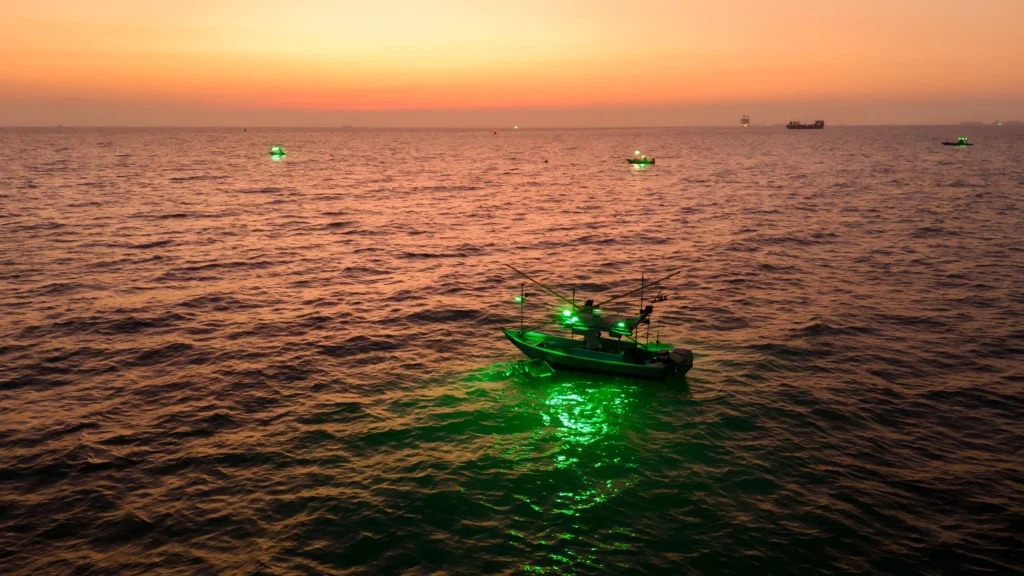
As global climate models become increasingly unpredictable, the maritime industry is facing unprecedented security challenges. Rising sea levels, intensifying storm surges and increasingly strong atmospheric conditions are changing the operating environment of ships around the world. The reliability of marine navigation lights has become more important than ever in this context.
These important signal devices are the ‘ language of the sea ‘, ensuring that ships are able to communicate their position, status and course, thereby preventing collisions. However, climate change has introduced pressure factors that traditional lighting systems have not been designed to cope with.
This guide will explore the ongoing changes in the field of maritime signals and how to adjust marine navigation lights to adapt to the harsh environment in the future.
Understanding the Main Functions of Marine Navigation Lights

Before analyzing the impact of climate change, it is necessary to understand the core functions of these devices. Marine navigation lights are not only for lighting ; they are statutory signal tools governed by the International Regulations for Preventing Collisions at Sea (COLREGs).
Their Main Functions Include:
- Direction Determination: By observing the color of the light and the angle of illumination ( e.g., green starboard lights and red port lights ), seafarers can immediately determine the direction of another ship.
- Indication Status: Specific lighting configuration can indicate whether the ship is anchored, stranded, engaged in fishing operations or limited maneuverability.
- Determine the Size and Type: The vertical spacing and number of mast lights help to identify the size of the ship and whether it is towing other objects.
- Notes for Seafarers: Proper maintenance of these lamps is not only a safety recommendation, but also a legal requirement. The failure of marine navigation lights may lead to catastrophic accidents and heavy legal penalties.
Key Impacts of Climate Change on Marine Navigation Lights
Climate change is no longer a distant threat ; it is gradually destroying maritime infrastructure. For marine navigation lights, the impact is mainly reflected in three aspects : physical damage, reduced visibility and energy unpredictability.
Increase of Salinity and Corrosion Rate
The increase of sea surface temperature and evaporation rate leads to the increase of sea water salinity in many areas. Combined with more frequent and violent storms, marine navigation lights are exposed to higher concentrations of salt fog.
Problem: Salt accumulation will corrode the shell seal and obscure the lens, significantly reducing the light output.
Consequences: Traditional aluminum or low-grade steel casings will accelerate deterioration that result in water and electrical failure.

Extreme Weather and Thermal Shocks
Climate change has led to severe temperature fluctuations. Marine navigation lights may suffer from strong ultraviolet radiation in heat waves during the day and suffer from freezing storms at night.
Thermal Shock: This rapid thermal expansion and contraction will break the old polycarbonate lens and destroy the seal of the incandescent bulb.
Physical Trauma: The increase in wave height means that the luminaires installed on the buoy are subjected to greater gravitational acceleration ( G-force ) and physical impact.
Atmospheric Shielding (Fog and Haze)
Warming air can hold more water that results in denser, longer duration of fog and heavy precipitation events.
Scattering Effect: Water droplets in the air scatter light beams. Standard marine navigation lights may be difficult to penetrate these dense layers, and in fact their visual range is reduced below the COLREGs requirements.
Reduced Solar Autonomy
Many modern navigation aids ( AtoN ) rely on solar power. However, the prolonged cloud cover caused by the anomalous weather system will deplete the battery. If the solar marine lights are not properly configured for these ‘ no sunshine ‘ days, the system may fail when it is most needed – during the storm.
Comparative Analysis: Traditional Lighting vs. Climate-adapted Lighting
In order to better understand the required transformation, the following table compares the performance of old technologies and modern solutions under climate pressure.
| Comparative Table: Traditional vs. Climate-Resilient Lighting | ||
|---|---|---|
| Feature | Traditional Halogen/Incandescent Lights | Modern LED Marine Navigation Lights |
| Light-Source | Filament lamp – fragile, high heat | Light emitting diode – solid state, cold light source |
| Vibration Resistance | Low – Filament breaks easily on rough seas | High – no moving parts, impact resistance |
| Energy Efficiency | Low-energy is mostly wasted in the form of heat | High – essential for solar autonomy |
| Lens Material | Glass or ordinary plastic ( easy to break ) | Anti-ultraviolet polycarbonate or acrylic acid |
| Climate Resilience | Low: Vulnerable to thermal shock and moisture. | High: designed for extreme temperatures and IP68 waterproof design |
How to Adapt the Impact of Climate Change on Marine Navigation Lights
In order to adapt to these environmental changes, we need to take a proactive approach. Maritime operators and port authorities must upgrade their marine navigation lights to ensure that they can continue to operate under harsh conditions.
Transition to High-Intensity LEDs
The most effective adaptation strategy is to replace marine incandescent lights with high-intensity LEDs.
Why? LED power consumption is reduced by up to 90 % allowing the use of smaller, more robust solar power systems.
In addition, modern LEDs can pulse ( flicker ) at a specific frequency that penetrate fog more effectively than static beams.
Implement intelligent monitoring ( IoT )
As the weather becomes unpredictable, manual inspection of navigational aids becomes dangerous and difficult.
The Solution: Integrate marine navigation lights with AIS (Automatic Identification System) and GSM monitoring.
Benefits: If a light fails, the battery is low, or the buoy drifts away due to the storm, the operator can receive real-time alerts for immediate remote diagnosis.
Priority is Given to IP68 and UV-resistant Materials
When selecting the marine navigation light, please ensure that the IP ( protection level ) is at least IP67 or IP68.
IP68: Indicates that the marine navigation light can be immersed in water – this is necessary for buoy installation luminaires under high swell conditions.
Materials: Look for hulls made of marine-grade bronze or UV-resistant polycarbonate that resist the yellowing effect caused by intense solar radiation ( yellowing changes the signal color ).
Redefining Solar Autonomous Computing
The standard size configuration of solar panels and batteries may no longer be applicable.
Adjustments: If your area is now experiencing a longer monsoon season or extended cloudy days, please increase the ‘ autonomous days ‘ specification for your marine navigation lights.
For example, it may be necessary to increase the standard 5-day autonomy to 14 or 21 days to ensure reliability in long-term severe weather events.

Further Learning About Marine Navigation Lights
The reliability of marine navigation light is a compliance issue and also a survival issue. As climate change reshapes the marine environment through more intense storms and thicker atmospheres, our technology for navigation must evolve accordingly.
By understanding the impact of climate change and transitioning to a robust, intelligent and energy-efficient LED system, ship operators can ensure that their signals are always clear, bright and visible regardless of the weather.For further reading of international safety standards, please visit the International Maritime Organization (IMO) for the latest updates on COLREGs and maritime safety.
You May Want to Read:
How to Select, Mount, and Use a Spotlight in Marine Navigation at Night
Different Types of Navigation Boat Lights and Its’ Usage Rules
FAQ
Under normal conditions, a quarterly inspection is recommended. However, in areas affected by climate change (increased storms/salt spray), monthly visual checks and cleaning of the lens are advised to maintain the required range of visibility.
High-quality solar marine navigation lights are designed to withstand wind speeds up to 140mph. However, the mounting hardware is often the weak point. Ensure that the mounting flange and bolts are reinforced and checked for corrosion regularly.
Yes, but the color temperature matters. “Cool white” LEDs can sometimes cause glare in fog (similar to high beams in a car). For navigation, the specific red, green, and yellow wavelengths used in certified lights are designed to penetrate atmospheric moisture, but higher intensity (candela) is required in reduced visibility conditions.
Yes. Climate change is leading to record-breaking global temperatures. Overheating can lead to performance degradation of standard lead-acid batteries and shorten the life of some lithium-ion batteries. In order to extend the service life, it is recommended to choose a beacon lamp equipped with a high temperature resistant LiFePO4 battery. Compared with traditional batteries, this kind of battery has better thermal stability and safety in a high temperature environment.