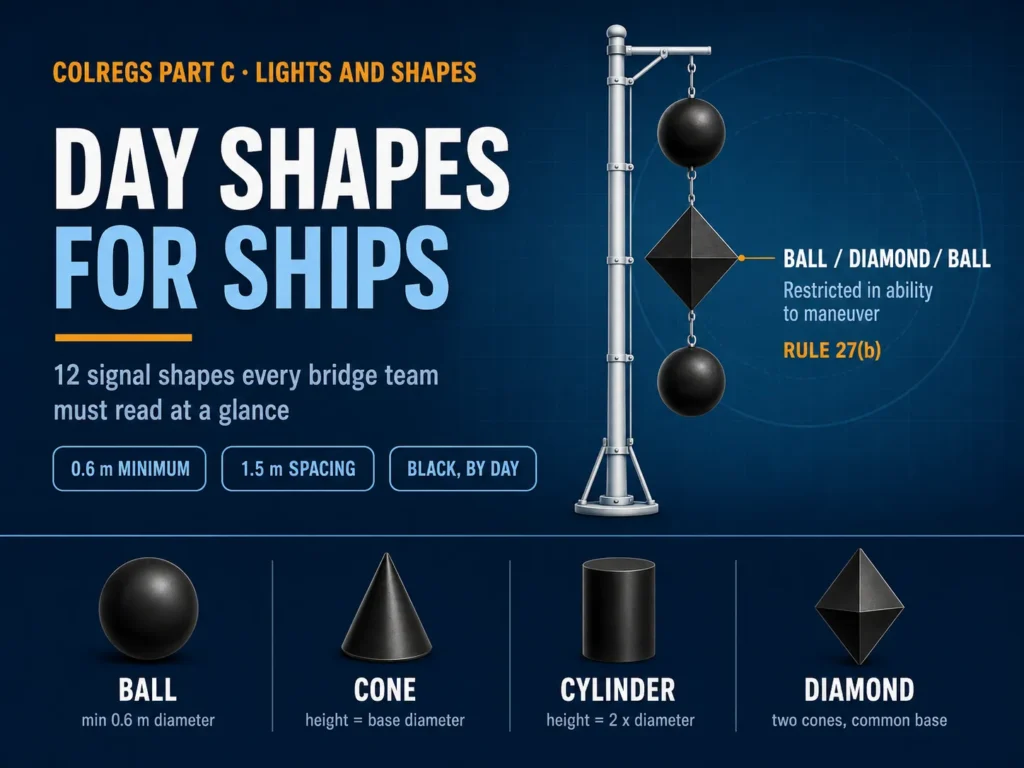
Can you name the shape a dredge shows on the side you must not pass? Would your deck crew hoist the correct signal at 1400 in a crowded anchorage? Day shapes look simple on a training poster, yet the combinations, size limits and exemptions catch out experienced watchkeepers. This guide sorts the 12 signal shapes ships actually use, with the rule number behind each one.
What Do the 12 Ship Day Shapes Mean?
According to Chapter C of COLREGs, there are 12 day shapes with clear meanings. The U.S.Coast Guard’s “Inland Navigation Rules” is incorporated into 33 CFR 83.27.As of August 2026, it is the current version of eCFR, which stipulates that three spherical bodies are used for mine clearance operations, and the combination of spherical bodies, rhombic bodies, and spherical bodies is used for ships with limited maneuverability.
The type is interpreted according to the vertical arrangement of the whole figure, rather than a single object, so the position and quantity are equally important. Two spherical bodies and three spherical bodies are separated by only one in the rules, but they represent very different dangers on the water surface.
| Signal shape | Meaning | Rule |
|---|---|---|
| One ball, forward | At anchor | Rule 30(a) |
| Two balls, vertical | Not under command | Rule 27(a) |
| Three balls, vertical | Aground | Rule 30(d) |
| Ball, diamond, ball | Restricted in ability to maneuver | Rule 27(b) |
| Two balls one side, two diamonds the other | Dredging or underwater work: obstructed side, passing side | Rule 27(d) |
| Three balls, foremast head and fore yard | Mine clearance, keep 1,000 m clear | Rule 27(f) |
| Rigid Flag A replica, 1 m minimum | Diving operations from a small vessel | Rule 27(e) |
| Cone, apex down, forward | Under sail and machinery together | Rule 25(e) |
| Two cones, apexes together | Engaged in fishing or trawling | Rule 26(b) and 26(c) |
| Cone, apex up | Outlying gear beyond 150 m, pointing at the gear | Rule 26(c) |
| Diamond | Tow exceeds 200 m, shown by tug and tow | Rule 24(a) and 24(e) |
| Cylinder | Constrained by draught, international waters only | Rule 28 |
One group of combinations in particular need to pay attention. Rule 27 (d) of the Code provides that a dredger shall display two spherical bodies on one side of the ship in the presence of obstacles and two diamond bodies on the other side through which the ship may pass. Once the interpretation is reversed, the consequence is not embarrassment but grounding.
Each of the above signals has corresponding night lights in the same clause, which is the reason why the bridge usually purchases the model and the lights together. The purchaser who needs to compare the light configuration item by item according to the terms and conditions can start with the marine navigation signal light product series and reverse the model required for each ship state.
How Big Must Signal Shapes Be Under Annex I?
According to Appendix I of COLREGs (Annex I), the diameter of the spherical body should not be less than 0.6 meters, and the vertical spacing between each type should not be less than 1.5 meters. These values are also adopted by the US regulation 33 CFR 84.06, and eCFR shows that it is the current effective version in August 2026.
The remaining geometric dimensions are derived from the spherical body. The diameter of the bottom surface of the cone should not be less than 0.6 meters, and the height is equal to the diameter of the bottom surface; the diameter of the cylinder shall not be less than 0.6 meters, and the height is twice its diameter; the diamond body is composed of two cones connected at the same bottom.
Appendix 1 clearly stipulates that the color of the model should be black. Black helps the size to maintain long-distance visibility in the background of sky, superstructure and sea fog.
Small ships can be exempted. For ships with a length of less than 20 metres, Appendix 1 allows the use of smaller sizes commensurate with the ship’s dimensions, and the vertical spacing can be reduced accordingly. The rules do not set a lower limit for this reduction, so the surveyor is determined by visibility rather than specific values.
Field notes: the pad wrapped in black cloth does not constitute a day shape. Appendix 1 requires a three-dimensional shape with a definite contour, and the wheel inspector will evaluate whether the silhouette can be correctly identified in any orientation.
Diving is the exception to the geometric family. Rule 27(e) calls for a rigid replica of International Code flag A, not less than 1 m in height, with measures taken to ensure all-round visibility. Vessels ordering equipment against class rules should cross-check their CCS and ABS type-approval certificates before the next survey window.
When Are Day Shapes Required, and Who Is Exempt?
According to Rule 20 of the “Rules for Navigation in Internal Waters,” ships must comply with it during the day and under any weather conditions. The scope of the exemption is narrow:
- Ships with a length of less than 7 m and anchored outside the fairway
- Ships with Rule 27 signals and less than 12 metres in length
According to 33 CFR 27.3, the maximum civil penalty for a single violation has reached $ 18,610 since December 2025. The amount of the fine is derived from the December 2025 civil penalty inflation adjustment. The U.S.Coast Guard has set the maximum fine for a single violation of the “Internal Water Navigation Rules” (33 U.S.C.2072) and the “International Navigation Rules” (33 U.S.C.1608) at USD 18,610, and the same standard applies to operators and ships.
The specific provisions of the exemption clause are as follows:
- Rule 30 (e) only exempts ships with a length of less than 7 meters from the obligation to display when anchoring in narrow waterways, waterways, anchorages or other waters where other ships usually navigate;
- Rule 30 (g) exempts ships with a length of less than 20 m and anchored in a specified anchorage;
- Rule 27 (g) exempts ships with a length of less than 12 m from showing loss of control and limited maneuverability, but when engaged in diving operations, it must be displayed regardless of the length of the ship.
- Rule 30 (f) applies the same 12 m limit to grounding signals.
Complying with the rules is not only to avoid punishment. The U.S. Coast Guard recorded 3,887 accidents and $ 88 million in property damage in the “2024 Yacht Voyage Statistics” released by the U.S. Coast Guard in 2025. Violation of navigation rules is one of the five major contributing factors. For shipowners who are configuring a complete list of signal equipment, they can refer to the four types of marine signal products required for compliant ships.
Where Do International and Inland Day Shapes Differ?
There are three main differences between the international rules and the US internal water rules in terms of day shapes:
First, Rule 28 of the United States Internal Water Code is a reservation clause, so the cylinder used by draught ships is not applicable in the United States internal waters.
Second, international rule 26 allows fishing vessels with a length of less than 20 m to replace two cones with a basket, but the Coast Guard does not include this option in 33 CFR 83.26.
Thirdly, the display requirements of the cone are different when the sails are used together. A 10 m sailboat in the Chesapeake Bay is not required to display a cone when it is opened and sailed, and the same ship must be displayed when crossing the Atlantic Ocean. This difference is most likely to make the captain ignore or make mistakes.
| Point of difference | International COLREGs | U.S. Inland Rules (33 CFR 83) |
|---|---|---|
| Constrained by draught | Cylinder, Rule 28 | Rule 28 reserved, no cylinder |
| Motor-sailing cone | Required, no length exemption | Not required under 12 m, Rule 25(e) |
| Fishing shape, vessel under 20 m | Basket permitted instead of two cones | Two cones only |
| Tow over 200 m, partly submerged object | Diamond aft plus a second diamond forward | Single diamond at aftermost extremity |
| Annex I shape list | Ball, cone, cylinder, diamond | Ball, cone, diamond, 33 CFR 84.06 |
It is for this reason that the US Coast Guard’s “Navigation Rules and Regulations Manual” (revised in August 2024) juxtaposes the two sets of rules. When the ship crosses the dividing line, the relevant obligations change immediately on the line, rather than waiting until the next port. The list of bridge equipment should be configured according to the maximum operating area, which is consistent with the processing logic of marine sound equipment in Annex III.
How Do Day Shapes Pair With Navigation Lights?
Each day shape has a corresponding light at night. Pursuant to regulation 27 (a), out-of-control ships display two spheres during the day and two vertical ring lights at night; according to Rule 20 (c), these lights should also be lit during the day when visibility is poor, so both sets of equipment must be equipped and remain available.
| Vessel status | Signal shape | Night lights |
|---|---|---|
| At anchor | One ball | All-round white forward, second aft |
| Not under command | Two balls | Two all-round red, vertical |
| Restricted in ability to maneuver | Ball, diamond, ball | Red, white, red, vertical |
| Trawling | Two cones, apexes together | Green over white, all-round |
| Constrained by draught | Cylinder | Three all-round red, vertical |
It can be seen from the table that the vertically arranged paired and group structures appear repeatedly in the two columns. This is precisely why many ships choose double-layer lights instead of installing two separate single-layer lamps, such as double-layer LED marine navigation signal lights.
Human factors make this relationship more important. The European Maritime Safety Agency (EMSA) reported in the “2025 Annual Review of Maritime Accidents and Events” that 78.8% of the investigated accidents involved human factors, and collisions were the leading cause of death in ship-related incidents.
If the model cannot be seen from all directions, no information can be transmitted. The suspension points on the front support cable, the mast cross truss or the signal mast should ensure that the contour of the model is not blocked within 360 degrees and is consistent with the radian covered by the corresponding ambient luminaire.
FAQ
A single black ball hoisted forward means the vessel is at anchor, under Rule 30(a). It is the daylight equivalent of the forward all-round white anchor light. Vessels under 7 m are excused when anchored clear of a narrow channel, fairway, anchorage or waters where other vessels normally navigate.
A ball needs a diameter of at least 0.6 m, a cone a base diameter of at least 0.6 m with equal height, and a cylinder 0.6 m diameter by twice that height. Annex I also requires at least 1.5 m of vertical separation. Vessels under 20 m may use proportionally smaller shapes.
Yes in most cases. Rule 30 requires the anchor ball for vessels of 7 m and over, with two exceptions: anchoring clear of channels and traffic in a vessel under 7 m, and anchoring inside a designated special anchorage area in a vessel under 20 m. Insurers and courts routinely ask whether it was displayed.
Under the Coast Guard’s December 2025 penalty adjustment at 33 CFR 27.3, a single navigation rules violation carries a maximum civil penalty of $18,610, applied to the operator and to the vessel. Vessels may also be seized under 33 U.S.C. 2072(b), and non-display frequently surfaces as contributory fault in collision claims.
Conclusion
Day shapes are part of the daytime display requirements in Chapter C of COLREGs, and their logic is completely consistent with the requirements of the lights. The 12 sets of configurations cover mooring, stranding, towing, fishing, dredging, diving and restricted draught. The size is from 0.6 m, and the vertical spacing is 1.5 m. The exemption conditions depend on the three captain’s boundaries of 7 m, 12 m and 20 m. The cylinder is no longer applicable when the ship enters the internal waters of the United States. Both sets of equipment must be matched and checked one by one before inspection.
Bozhou Marine manufactures CCS and ABS certified marine navigation signal lights in Yueqing, Zhejiang.